If you create an open source project, you already know the paradox. The work can matter enormously — libraries that run half the internet, tools people build companies on — and still be hard to monetize. There is little lock-in. Competition is free by design. You may be known as the original author, and still watch someone else become the most successful operator of what you made.
One durable answer has always been support. Canonical, Red Hat, and others turned expertise around free software into businesses. That model works. Until recently, though, it was an organizational model: sales teams, ticket queues, account managers, and enough headcount to look like a corporation. For a solo developer or a small core team, “become the support company” was rarely compatible with staying a builder.
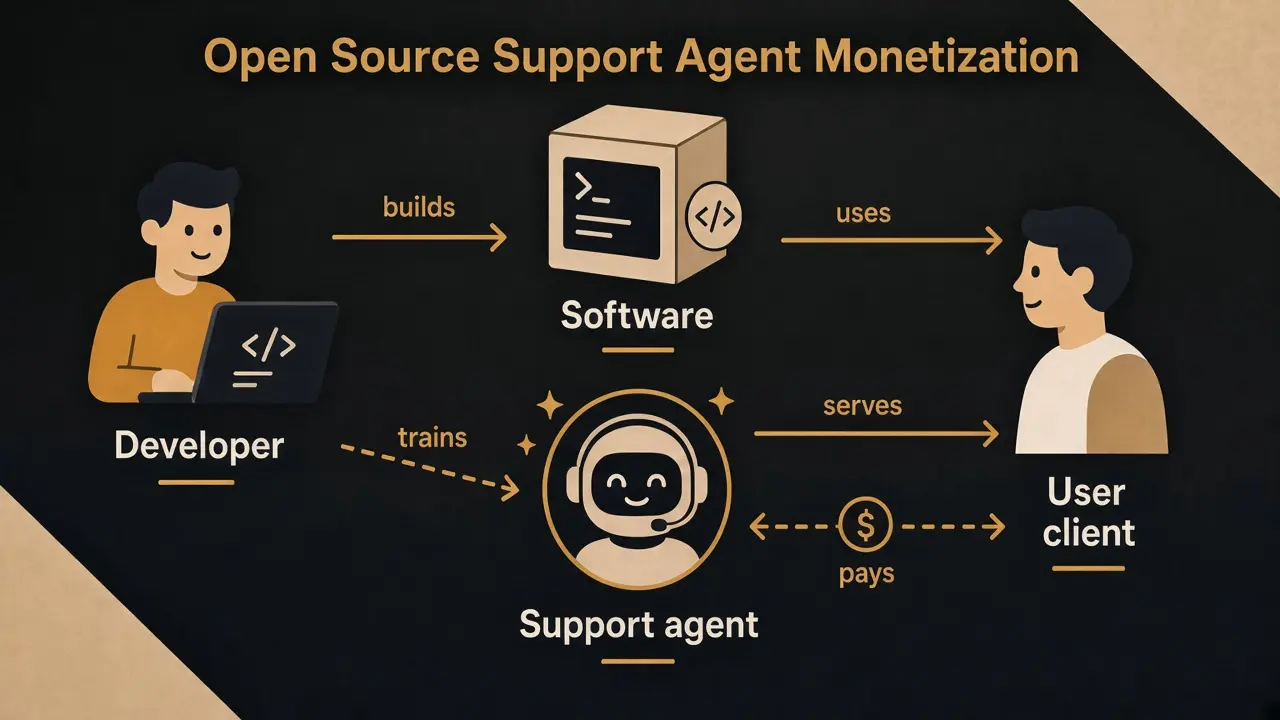
AI changes the unit economics of that path. An individual can now train and deploy not only an expert agent grounded in their own source, specs, and architecture, but also the supporting tools needed to close sales, take payment, and keep clients unblocked. The creator’s name still carries weight — people recognize the original author as a high-trust expert. Training a support agent is how you capture that expertise and serve it without answering every ticket yourself.
Call it expertise as a service: an LLM, some tools, and databases as the framework. The developer stays close to core capacity — design, code, judgment — instead of becoming a customer-support administrator. The agent does the repetitive work; escalation stays available when something actually needs a human.
The scale looks different from the old corporate support stack. Operational cost for a well-scoped agent can sit on the order of a dollar per support client per month. Charge five dollars, and you are looking at roughly an eighty percent margin on the service itself — illustrative numbers, not a forecast, but directionally real with today’s inference prices. In theory you could grow to a very large client base without reinventing the company every time you 10×: no need to hire a sales floor and a support org in lockstep with every new subscriber.
None of this replaces open source with a closed product. The software can stay free. What you sell is access to the person — or the agent trained by the person — who knows the system best. That is a cleaner story than pretending free software was never about business. It was always about leverage. AI just moved the leverage back toward the creator who is willing to encode their expertise and put a price on keeping others productive with it.